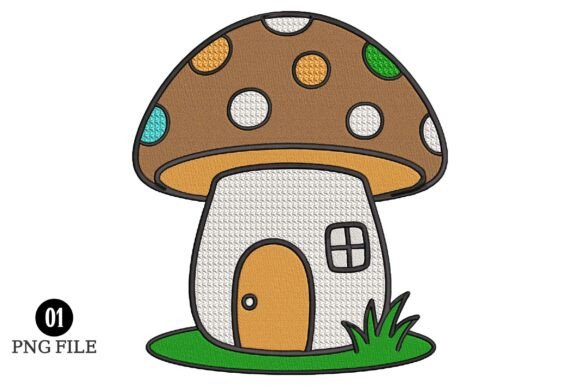
Cute Mushroom House Embroidery Design
First Impression: Whimsy That Stops Booth Shoppers in Their Tracks
As an embroidery designer who’s prepped over 200 craft fair booths, I can tell you—Cute Mushroom House Embroidery Design lands exactly where it needs to: pure, unapologetic whimsy. It’s not rustic. Not minimalist. Not elegant or edgy. It’s soft, joyful, and instantly nostalgic—the kind of design that makes adults smile and kids point. That’s gold at a handmade market. Customers don’t pause for “subtle.” They pause for story. And this mushroom house? It tells one in under two seconds.
Where It Shines: Craft Fair Products That Sell on Feeling, Not Function
This design thrives on items people buy for delight—not utility. On a tote bag design, it works best centered on the front panel (not too high, not too low), sized to fill about 60% of the width. Too small? It reads as clutter. Too large? The spots and roof details blur. On an apron embroidery, place it just above the pocket—it becomes a conversation starter while still feeling intentional and wearable. For tea towel embroidery, go medium scale (3.5–4.5 inches wide) on the lower corner or centered near the hem. Linen and cotton towels hold the stitch density beautifully, but avoid heavy terry textures—they swallow fine details.
Embroidered patches are where Cute Mushroom House Embroidery Design earns its keep. Stitched cleanly with satin borders and tight fill, it becomes a collectible. Pair it with matching thread colors (think coral stem, mossy green cap, buttery yellow door) and it reads as premium—even at $8–$12. On caps, proceed with caution: the curved surface distorts tiny spots and thin stems. Reserve it for structured, flat-front caps—and always test on scrap first. For pillow covers and small pouches, it’s ideal at 3–3.75 inches. The shape fits naturally within square or rounded corners, and the cheerful palette lifts neutral fabrics without overwhelming them.
What Holds It Back (And How to Fix It)
Let’s be real: “tiny details” in the product description aren’t just marketing fluff. This design has delicate elements—window frames, door handles, subtle grass tufts—that vanish below 2.75 inches. That means no 1.5-inch versions on keychains or tiny pins unless you simplify the file. Also, dense stitch areas (especially the cap’s spotted surface) demand proper stabilizer. Skip tear-away on lightweight cottons, and double-layer cut-away on knits or stretchy fabric pouches. Dark fabric? Boost contrast with brighter thread colors—avoid navy-on-black stems or charcoal spots. And if your booth includes textured towels or fleece-lined market bags, skip this design there entirely. Texture fights clarity.
Photography & Online Appeal: Why Your Etsy Seller Instincts Are Right
This is a printable mockup dream. Soft shadows, pastel backdrops, natural light—it photographs like a storybook. That matters because 80% of craft fair buyers check your Etsy seller page *before* they walk up to your table. A strong listing with three clean angles (flat lay, in-use, detail close-up) converts faster than any booth sign. Use the digital embroidery file to generate consistent mockups across tote bags, aprons, and patches—this builds brand consistency and signals professionalism. Just remember: if your online thumbnails look fuzzy or crowded, customers won’t click. Keep the background clean, the mushroom centered, and the color pop unmistakable.
Production Reality Check: Batch-Friendly or Booth-Draining?
Yes, Cute Mushroom House Embroidery Design is batch-friendly—if you respect its limits. It scales cleanly between 3" and 5", holds well across standard hoop sizes (4x4 and 5x7 are safest), and doesn’t require constant rehooping for repeat placements. But “tiny details” mean you must inspect each finished piece. A missed thread trim near the chimney or a skipped satin stitch on the door can downgrade a $28 pillow cover to “almost cute.” That’s why I always recommend: test the design on scrap fabric, check thread contrast under booth lighting, review spacing between elements before cutting production fabric, confirm hoop size compatibility with your machine, inspect stitch density for puckering, use the right stabilizer for your base fabric, create at least one real mockup, compare fabric colors side-by-side (a cream cap looks warm on oat linen but dull on ivory cotton), and confirm commercial licensing before selling finished products.
Booth Psychology: How This Design Moves Units
In a sea of botanical prints and monogrammed linens, Cute Mushroom House Embroidery Design creates visual breathing room. It’s unexpected but not alienating—familiar enough to feel safe, fresh enough to feel special. At a craft fair, it draws the “gift buyer”: moms shopping for teachers, friends grabbing birthday presents, collectors seeking limited-run handmade products. It also strengthens your booth display strength when grouped intentionally—e.g., a mushroom-embroidered tea towel next to a matching patch and a mini pouch. That trio says “curated,” not “random.” And because it reads as handmade quality, not mass-produced, it justifies higher price points without explanation.
Final Verdict: A High-Engagement, Medium-Complexity Workhorse
This isn’t a beginner-only file—but it’s not a master-class challenge either. It sits in that sweet spot: approachable enough for a small shop product line, distinctive enough to anchor a boutique maker’s identity. As a commercial embroidery asset, it supports multiple SKUs without diluting your voice. As a craft fair product, it sparks joy, invites touch, and encourages photo-sharing. Just honor its whimsy with precision: stabilize well, size thoughtfully, photograph honestly, and always—always—test before you commit yardage. Done right, Cute Mushroom House Embroidery Design doesn’t just sell. It starts conversations, builds loyalty, and turns first-time buyers into repeat fans.